
Copy Editor’s Corner | More Than vs. Over

Copyeditors are taught that over should be reserved for spatial relationships, as in “The cow jumped over the moon,” and more than be used with numerals. Josh’s salary didn’t increase by over 5 percent, it increased by more than 5 percent.

But this guideline needn’t be so rigid, especially if you’re the one in charge of the style guide. Bill Walsh, author of Lapsing Into a Comma: A Curmudgeon’s Guide to the Many Things That Can Go Wrong in Print – and How to Avoid Them, makes a case for bending this rule.

Walsh concedes that more than does indeed make the most sense for discrete numbers. His example:

More than 200 people attended the party.

But he points out that it makes less sense – and even calls it silly – to count collective amounts as units, one at a time. The reason more than works with the above example is that people can be counted as whole units, whereas time, space, and money can be broken down into much smaller units. For example, Walsh says, “more than 500 pounds” doesn’t include 500.5 pounds, but over does.

Walsh’s take on the subject is just another style preference, but it’s worth considering.

Share

Afternoon at Miriam’s Kitchen

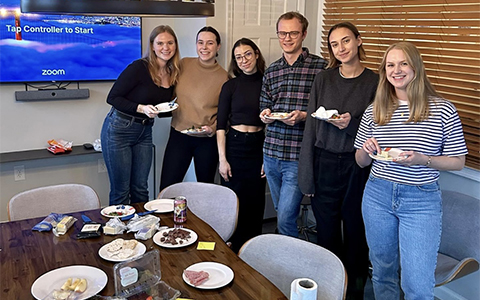
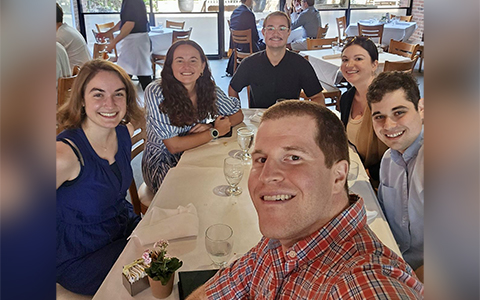
Last week, our company spent an afternoon preparing and serving food at Miriam’s Kitchen, a charity dedicated to ending chronic homelessness in Washington, DC. It was an eye-opening experience — and allowed our company to get out of the office and join together in a completely different way. We’d strongly recommend this charity to anyone, especially other DC businesses. Check out Miriam’s Kitchen at www.miriamskitchen.org and please consider donating to this great cause.

Share

PR Tips | Want Quick, Quality Hits? Go Local

Pitching a story or oped successfully takes a lot of hard work. In fact, it can be so difficult that many people – and even PR practitioners – simply give up. But if you pitch locally, your job suddenly becomes easier.

For example, let’s say you wanted to pitch a story about the mayor of a suburban town outside Philadelphia. If you tried pitching the Miami Herald, you’d probably strike out. You’d have a much better success rate if you targeted the Philadelphia Inquirer or a local paper because of the geographic connection.

So going local makes it easy to get fast hits. But what if you want to make a bigger splash? You can also apply this technique in reverse. There’s often a way to broaden the appeal of even the most local stories.

For example, let’s say the suburban mayor’s solution to his town’s unemployment crisis contains lessons for how other towns could solve their unemployment problems, as well. Voila. With a few small tweaks, we have national appeal.

To make our pitch even more attention-grabbing, we could plug in unemployment data for whatever state we’re pitching. If we pitch the Detroit Free Press, for example, we could call attention to Michigan statistics showing Detroit has a major unemployment problem – and our small-town mayor is offering a solution.… READ MORE

Share

PR Tips | Getting Started on a New Website

So, you need a website. We all do. But where do you start?

What in the world is MySQL? For that matter, what are Name Servers, A Records, Flash, HTML, PHP, SEO, IPS, WordPress, and FTP? There is a difference between hosting and domain registration?!?! And, what the heck is Lorem Ipsum?

The good news is you don’t need to know everything — that’s why you hire a professional. That said, a basic understanding of a few critical terms can be very helpful.

Think about the anatomy of a car. You’re probably not an auto-expert, but you do have a general knowledge of your vehicle’s parts — wheels, breaks, engine, transmission, etc. It helps to know those terms when you’re buying a car, just as it helps to know web-specific… READ MORE

Share

Advice from the Media | Chelsea Glenn Fuller

Name: Chelsea Glenn Fuller
Title: Reporter/Copy Editor
Media Outlet: The Dominion Post
Twitter Handle: Fulloffaith22
Personal Blog: Journalist Extraordinaire

1) Describe your typical workday in 140 characters or less.
Reporting days: Receive daily assignments, go do the interviews, come back and write. Editing days: Edit news copy, design, layout and proof pages.

2) What’s the best pitch you’ve ever received?
I would have to say the best pitch/scoop I’ve received thus far was from an elderly lady who bombarded my office with calls that my superiors brushed off. When I finally talked to her, she informed me that she lived in a large apartment complex for low income seniors. Many residents at the complex received free lunch from a local state funded senior center. For most of the residents the lunch was their only hot meal of the day, and the number of lunches served was cut significantly without any explanation from the center or the apartment complex. That one scoop turned into seven top strip front page stories that exposed the agency’s mishandling of the meal program. Words of wisdom: Don’t ever totally disregard a pitch/scoop without listening to it first because you never know where your next big story will come from.

3) What are the greatest words of wisdom an editor ever gave you?
My first editor told me that I should never assume that my readers already know what I am writing about… even the simplest things that appear self-explanatory. She always reminded me that it is not just my job, but my responsibility to be thorough and to produce accurate content that people can trust. After making a classic junior reporter mistake (I failed to double check the spelling of a source’s name), she told me that taking extra time to double check sources, spelling and grammar are simple things that can separate good reporters from great reporters. There hasn’t been a single day in my career that I haven’t remembered those words.

4) If there was one thing you could tell every PR practitioner, what would it be?
Don’t underestimate the value of creating strong ties with reporters. Many PR professionals just send blanket releases to media outlets for the sake of convenience. But you would be surprised at the difference sending a personalized release can make. Good, relationships with reporters can be the difference between getting coverage for your client and having your release sent to the bottom of the stack. … READ MORE

Share

Copy Editor’s Corner | Adverbs Badverbs

How many times has someone “corrected” you when you’ve said, “I feel bad,” telling you it should be “I feel badly”?

When people are overcorrected they begin to feel a bit paranoid that they’re never right, and that it’s never okay to say “I feel bad” when they feel guilty about something.

But it is not really correct to say “I feel badly” unless you mean “I have a poor sense of touch.” And how many people can say that and actually mean it? Badly and well are both adverbs (they are added to a verb to modify its meaning), while bad and good are adjectives. A person can do something badly or well, or she can feel bad or good.

Ellen cooks bad and Jamie listens good are obviously grammatically incorrect. It’s helpful to plug tricky words into other sentences to see if they make sense – a technique copy editors sometimes use when they get stuck.

Share
  • SUBSCRIBE BY EMAIL

    * = required field
  • CATEGORIES

  • CONTRIBUTORS

  • LATEST TWEETS

  • ARCHIVES